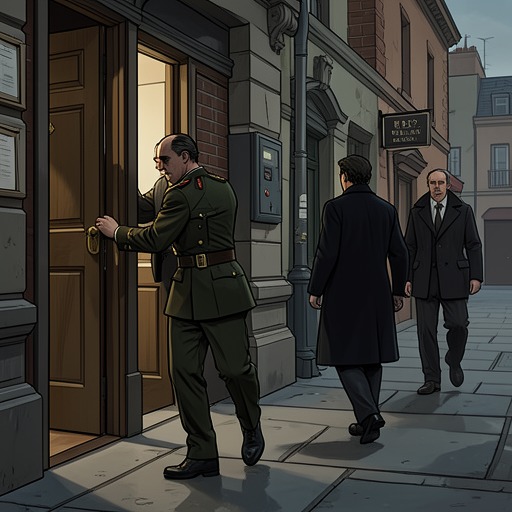
Duncan refuses to honor his promised reward to Banco
The KillerDuncan refuses to honor his promised reward to Banco by turning a claim about Glamiss’s death into a demand for physical proof. The exchange begins as a dispute over title and lands, but ends with Banco expelled and Duncan privately warning that, if Banco becomes dangerous, he must be watched carefully. The promise is thus weakened not only by Duncan’s denial but by the sovereign’s ability to decide what counts as evidence and when a former ally becomes a threat.
Promise and political circumstances
Banco arrives seeking the reward he says Duncan promised if Glamiss were captured, dead or alive. The officer tells him that Duncan has already given Glamiss’s title to Macbett and regards the decision as a fait accompli; he adds that it is only Duncan’s word. That explanation sets out the practical obstacle before Duncan appears: Banco is asking for an award whose terms, timing, and fulfillment remain under the king’s control, while Glamiss’s title has already been reassigned.
The officer also says Duncan has been told that Glamiss is dead, drowned. Lady Duncan learned of the death through her Lady in Waiting, so the news has reached the royal household by a separate channel. Banco nonetheless insists on his own claim: he wants the title or the lands, if not both. His complaint is not that the capture failed, but that Duncan’s promise has not produced the reward Banco expected.
Duncan’s demand for proof
Duncan enters from stage right and asks what the fuss is about, then says he does not like being disturbed. Banco reminds him of the promise: once Glamiss had been taken, dead or alive, Duncan would reward him. Duncan answers by asking where Glamiss is, claiming that he does not see him. When Banco says Duncan knows Glamiss drowned, Duncan dismisses the report as hearsay and tells Banco to bring the body. Banco replies that the bloated corpse has been swept out to sea; Duncan’s response is to tell him to go and look for it, taking a boat.
The exchange makes the body the demanded proof even though the officer has already said Duncan heard of the death, and the report has circulated within the royal household. Duncan’s insistence converts the practical impossibility of producing a corpse swept out to sea into a reason to defer payment. Banco has appealed to the original condition of the promise, which allowed for Glamiss to be captured dead or alive; Duncan now treats a dead captive as unverified unless Banco can present the body. The terms appear to shift from the event of capture to evidence Duncan alone will accept.
Dispute, dismissal, and threat
Banco persists. Duncan cuts him off and asks where Glamiss’s body is, demanding the corpus delicti. Banco responds that Glamiss’s death is common knowledge and points to the consequence already visible in the court’s decisions: Duncan has given Glamiss’s title to Macbett. When Duncan asks whether Banco is demanding an explanation, Banco says that it is not fair. The argument has moved from the promised reward to the legitimacy of Duncan’s handling of the case, but Banco’s protest does not change the decision.
Duncan asks how Banco dares to insult him and orders that he be shown the door. The officer appears ready to launch himself violently at Banco and shouts at him to leave. Yet Duncan immediately checks the escalation: he says there is no need for rough treatment, calls Banco a good friend, and suggests that his nerves are merely on edge and that he will recover. He also promises that Banco will get his opportunity, leaving the prospect of future reward open without specifying when or on what terms. Banco exits muttering his anger rather than receiving either the title or the lands he requested.
Duncan’s private explanation
After Banco has gone, Duncan tells the officer that he does not know what came over him and admits that he should have made Banco a baron. He then identifies the competing claim behind his refusal: Banco wanted the money as well, and Duncan says that money should rightfully have reverted to him. The private explanation gives the dispute a material dimension that Duncan did not acknowledge in the confrontation. His public demand for a corpse is not the only obstacle to the reward; the money itself is something he wants to keep.
Duncan ends by saying that if Banco gets dangerous, they will have to be very careful. The officer puts his hand on his sword and says he understands. The gesture gives Duncan’s warning an immediate coercive edge, although no further violence occurs in this exchange. Duncan’s public reassurance that Banco is a friend thus sits beside a private assessment of him as a possible danger, and the promise of a future opportunity remains shadowed by surveillance and force.
Significance of the refusal
The scene turns a royal promise into a contest over who controls its interpretation. Banco cites the condition as he understood it; Duncan answers by imposing a stricter test, the recovery of Glamiss’s body, despite the stated fact that the corpse has been swept out to sea. The reassignment of Glamiss’s title to Macbett further shows that Duncan has already acted on the death in one respect while refusing to accept it as sufficient proof in another. The gap between those positions leaves Banco without his reward and without a persuasive avenue of appeal.
The refusal also changes the relationship between Duncan and Banco. Banco enters as a claimant who expects a promised payment from his lord; he leaves after being ordered out, with the officer’s near-attack checked by Duncan’s instruction but not erased by his warning. Duncan’s admission about the money and his caution about Banco reveal the calculation beneath the language of friendship. In this episode, royal favor can be offered, withheld, and postponed at the ruler’s discretion, while a subordinate’s insistence on fairness can be recast as insolence and possible danger.